WORLDLINE viewer (ui/)
Included from the repository
This page is ui/README.md from the repository, included as written.
Static Vite + React + TypeScript viewer over the JSON that the WORLDLINE pipeline writes to experiments/out/. No backend, no UI kit: hand-written CSS, plain SVG, light/dark via prefers-color-scheme. Built with base: './' so it deploys unchanged under a GitLab Pages subpath.
Every scenario is simulated. A "Simulated scenario" badge in the top bar explains the split on hover or keyboard focus: the world itself (scenario, actors, messages, timing faults) is synthetic; every count, timing, verdict and signature shown about it is measured by the pipeline and can be re-checked. A persistent footer repeats the scope: "All scenarios synthetic. Transfer is within the shared Event v1 substrate, not across heterogeneous codebases."
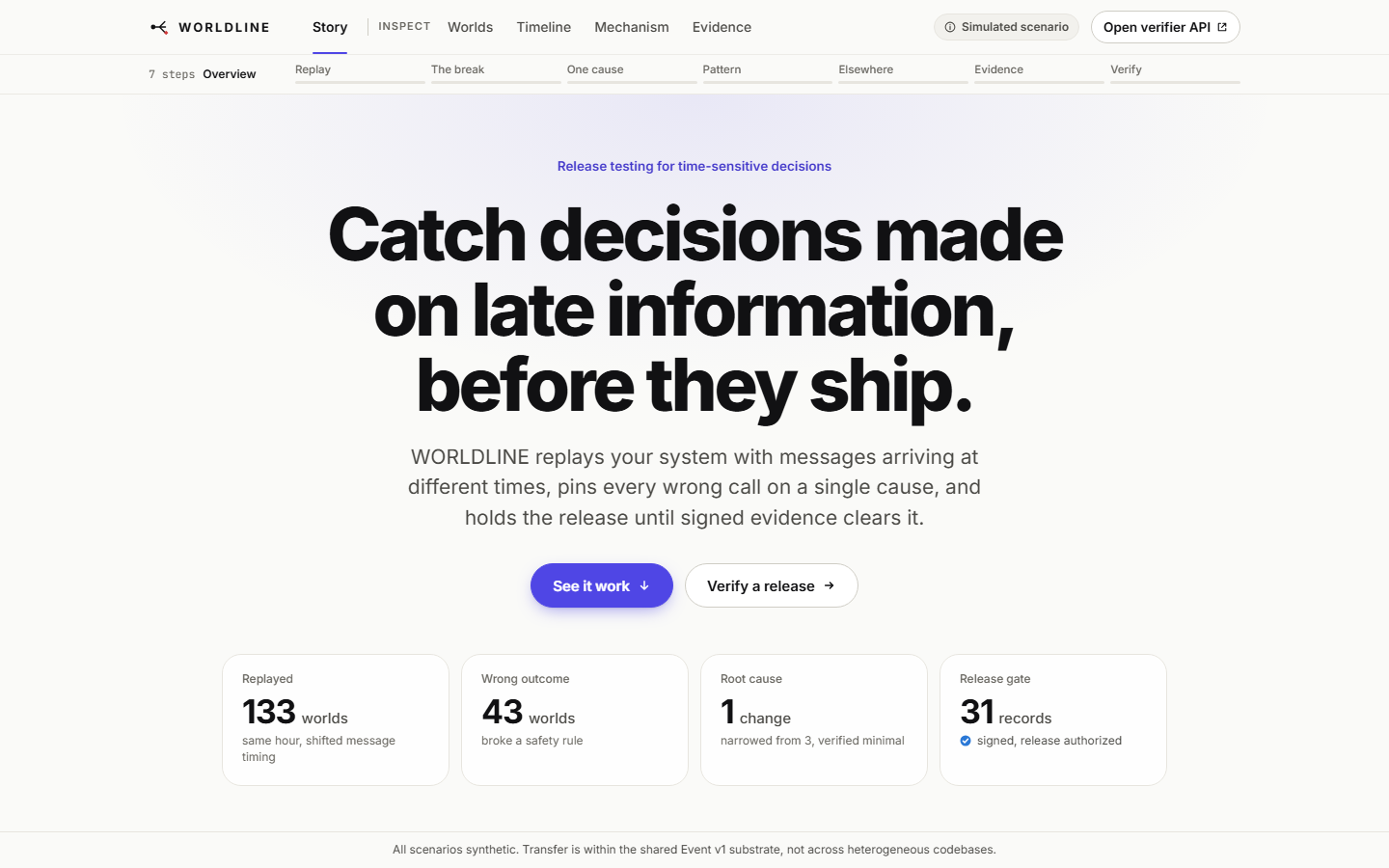
Story (default route #/)
A hero states the run in four numbers (worlds replayed, worlds with a wrong outcome, the size of the root cause, records behind the release gate). Below it, seven full-width beats each carry a headline, a short lede and one visual. Headlines and the short labels of the progress bar come from STORY_BEATS in src/config.ts; every number comes from the data files.
| # | Progress label | Headline | What it shows |
|---|---|---|---|
| 1 | Replay | One hour, replayed N ways | Every exploration run as a half-circle fan (failing worlds as red diamonds), a strategy toggle, and guided vs random as two large numbers and a per-100 bar pair. |
| 2 | The break | The replay that broke | The minimal counterexample in three lanes (what actually happened, the deciding role, one other role). The held-back correction slides past the decision marker; a play button and scrubber show what the decider knew at each moment. |
| 3 | One cause | Narrowed to one cause | The ddmin result as "N changes tried, 1 explains it". Removed changes are dashed and struck through, with a "Removed" label; the kept one is outlined in red. Checks for one_minimal_verified and self_explaining. |
| 4 | Pattern | A pattern, not a one-off bug | The genome as a sentence, a kind → role → decision diagram, and the preconditions as checklist chips. |
| 5 | Elsewhere | Tested on a different system | The challenge: the look-alike scenario (reproduced) and the immune twin (preconditions met, not reproduced) as two cards. |
| 6 | Evidence | The release waits for signed evidence | The bundle as records grouped by producer (agent, kernel), certainty shown by shape and colour, and an AUTHORIZED / DENIED toggle that names the edited record. |
| 7 | Verify | Verify a release yourself | Two steps against the live verifier. 1 Choose a bundle (the shipped bundle.json, the edited copy bundle_tampered.json, or your own file) and press Verify bundle (POST /api/verify). 2 Check the release gate (POST /api/authorize with the release policy). A "Run it from a terminal" panel gives the matching curl commands. Endpoints are defined once, in src/config.ts. |
A seven-segment progress bar under the top bar tracks the beat on screen; each segment jumps to its beat. #/story/<n> deep-links to beat n. Raw sha256 strings never appear in the default view: identifiers show as 7-character short ids with a copy button, and the full value is in the tooltip and on the clipboard (src/components/ShortId.tsx).
Inspect views
Each Inspect view opens with the question it answers and a one-paragraph answer computed from the data, then a context bar, then the detail.
| View | Question | What it shows | Screenshot |
|---|---|---|---|
Worlds #/worlds |
Which worlds broke, and why? | A strategy switch over every run in exploration.json (guided, random, windowed when present, or all merged). Filter chips for what broke and the change type, plus "Include worlds that held". A sortable table with one row per distinct schedule (arrow keys move, Enter opens the timeline) and a side panel for the selected world: its changes, verdicts and technical details. Collapsed below: the branch tree (parent → child) and a per-strategy comparison table (n_nodes, n_failing, failing_rate_per_100, first_decision_fail_index, wall_ms from exploration.comparison, definitions on hover). |
docs/screens/worlds.png |
Timeline #/timeline |
What did each role know, and when? | A world picker (baseline, minimal counterexample, challenge counterexample, failing worlds grouped by strategy). One lane per role: each event sits at event_time_ns with a line to received_time_ns, decisions are diamonds, FAIL-witness events are ringed. A known-at scrubber with previous/next-arrival steps dims what has not arrived yet; event-kind toggles filter the lanes; Compare with the baseline overlays the root's arrival times and lists every difference (off for the challenge trace, which is a different scenario). Click an event to pin it. |
docs/screens/timeline-inspect.png |
Mechanism #/mechanism |
What is the single cause, and does it transfer? | Three steps. 1 Minimize (ddmin): changes tried vs kept, the reduction steps, and the one_minimal_verified / self_explaining checks. 2 Abstract (genome.extract): the mechanism sentence, its evidence kind, and the preconditions with their machine names. 3 Challenge (genome.challenge): the look-alike scenario and the immune twin, each with its preconditions, the planted change and the verdicts. |
docs/screens/mechanism.png |
Evidence #/evidence |
Why was this release allowed? | A switch between the real bundle (authorization.json) and the edited copy (authorization_denied.json). The decision banner and its reasons, what the policy requires and which records satisfy it, and the evidence grouped by claim: each record has a certainty badge (shape and colour), a producer tag and its raw JSON, and the edited record is flagged. Below, Does it hold beyond one seed? from benchmark.json: exploration aggregates for every strategy (guided, random, windowed) and ddmin aggregates (mean / median over seeds), definitions on hover and in full, and the claim ceiling. |
docs/screens/evidence-inspect.png |
Other screenshots in docs/screens/: timeline.png (Story beat 2), evidence.png (Story beat 6), verify.png (Story beat 7) and mobile.png (390 px wide).
Run
Prerequisites: Node 20+ (tested on Node 24).
cd ui
npm ci
npm run dev          # http://localhost:5173, serves ./fixtures as ./data via a Vite middleware
npm run build        # copy-data + typecheck + vite build -> ui/dist
npm run preview      # serve ui/dist locally (http://localhost:4173)
Other scripts:
npm run copy-data    # copies ../experiments/out -> public/data if it has JSON, else ./fixtures
npm run typecheck
Tests
A Playwright suite in e2e/ (42 tests: routes, key numbers, keyboard, 390 px layout, dark mode, axe in light and dark, JS and first-paint budgets) runs against vite preview serving the built bundle. Coverage, budgets and how to read failures: docs/UI_QA.md.
npx playwright install chromium     # once per machine
npm run build
npm run test:e2e                    # serves dist/ on http://localhost:4317 and runs the suite
npx playwright show-report e2e/.output/report

# Isolated build, safe when someone else rebuilds dist/ at the same time:
node e2e/build-snapshot.mjs && E2E_DIST=e2e/.output/dist npm run test:e2e
npm run test:e2e:ci is what CI runs (--forbid-only).
Screenshots
docs/screens/*.png are taken from npm run preview with headless Edge at 1440x900, for example:
& "C:\Program Files (x86)\Microsoft\Edge\Application\msedge.exe" --headless=new --disable-gpu --hide-scrollbars --window-size=1440,900 --virtual-time-budget=10000 --screenshot=..\docs\screens\worlds.png "http://localhost:4173/#/worlds"
How data is loaded
The app fetches relative URLs: new URL("data/<file>", document.baseURI). File names are fixed by the pipeline (see the contract below), so src/data.ts hardcodes them: it reads index.json, then exploration.json, minimal_schedule.json, genome.json, challenge.json, bundle.json, authorization.json in parallel, plus authorization_denied.json and benchmark.json when present. Traces and verdict files are fetched lazily when a trace is opened in Timeline, resolved through the registry built from exploration.trace_files, minimal_schedule.trace_files and challenge.primary.trace_file.
- Dev:
vite.config.tsregisters a small middleware that servesui/fixtures/**at./data/**. No copying needed. - Build:
npm run buildrunscopy-datafirst, which fillspublic/data/(gitignored). Vite copiespublic/verbatim, sodist/data/**ships next to the bundle. - CI / Pages: run the pipeline so
experiments/out/*.jsonexists, thennpm run build;copy-dataprefers the real output over the fixtures. Publishui/dist.
Data contract
The real files under experiments/out/ are authoritative; src/types.ts mirrors them and the UI adapts, never the pipeline. Written by worldline explore | minimize | genome extract | genome challenge | bundle | authorize | benchmark | report.
| File | Shape (top level) |
|---|---|
index.json |
Manifest from worldline report: generated_at, code_commit, environment, claim_ceiling, claims[] {id, claim, kind}, digests {root_trace_digest, minimal_trace_digest, minimal_schedule_hash, genome_id}, files {"<path>": {bytes, sha256}}. It is not a logical file map. |
exploration.json |
scenario_id, seed, budget, schedule_size, strategies, root_digest, runs {strategy: ExplorationRun} (guided, random, and windowed when the run includes it), comparison {strategy: {n_nodes, n_failing, failing_rate_per_100, first_decision_fail_index (null if none), wall_ms}}, trace_files {branch_id: {trace, verdicts, strategy?, failing_invariants?}}. An ExplorationRun has nodes[] {branch_id, parent, schedule, trace_digest, verdicts[], failing_invariants[], cost_ns}, failing[], n_nodes, n_failing, n_rejected, rejected[], wall_ns. All runs share root; traces are exported for root and failing branches only. |
minimal_schedule.json |
target_invariant, strategy, branch_id (the failing branch ddmin started from), original[], minimal[], minimal_branch_id, minimal_schedule_hash, trace_digest, oracle_calls, cache_hits, one_minimal_verified, self_explaining, steps[] {size, fails}, witness[], explanation, selection_rule, candidates_considered[], causal_diff {a, b, differs, truth_identical, decisions[], views{role: {received_time_moved[], ...}}}, trace_files {minimal, minimal_verdicts}. |
genome.json |
id, violated_invariant, mechanism[] {op, selector{kind, role, position, relation}, params}, mechanism_sentence, preconditions[], witness_shape, origin {scenario_id, seed, branch_id, trace_digest, minimal_schedule_hash, invariant_version, code_commit, witness[]}, evidence_kind, claim_ceiling. Selectors are abstract: no concrete event ids. |
challenge.json |
genome_id, success, seed_note, claim_ceiling, primary: ChallengeResult, controls[]: ChallengeResult. A ChallengeResult has scenario_id, target_rule, preconditions_met, preconditions_report {name: bool}, instantiated_schedule[], verdicts[], reproduced, counterexample_digest, explanation, and trace_file when a counterexample trace was written (traces/challenge_<scenario>.json). For a control, "preconditions met, not reproduced" is the success case. |
bundle.json |
format: "worldline.bundle.v1", records[] EvidenceRecord {id, kind, claim, subject, procedure, inputs_hash, result, assumptions[], derived_at, producer}, links[] {hash, prev_hash} (one per record, same index), checkpoint {root, first_index, last_index, sealed_at, signer_key_id, signature}. bundle_tampered.json is the same bundle with one record edited. |
authorization.json / authorization_denied.json |
decision: AUTHORIZED \| DENIED, policy (name), artifact_digest, bundle_file, evaluated_at, reasons[], satisfied[] {claim_pattern, record_id, kind, producer, ...}, missing[], stale[], downgraded[]. The denied file is the same policy evaluated on bundle_tampered.json; its reason names the edited record index (integrity:record_edited@<i>). |
benchmark.json |
scenario_id, seeds[], budget, schedule_size, target_invariant, claim_ceiling, definitions {metric: text}, environment, exploration {rows[], aggregate {strategy: {metric: {mean, median, n, n_null}, coverage_equal_all?, equivalence_violations_total?}}} (strategies guided, random, windowed), parallel?, minimization {cases[], skipped[], aggregate {metric: {...}, one_minimal_verified_all}}. |
traces/*.json |
Trace: scenario_id, seed, branch_id, fault_schedule_hash, truth {events[], digest}, views {role: {events[], digest}}, decisions[], clock_end, scenario (embedded spec: roles[] {id, delivery, visibility}, actors[] {id, role, decision_rules[]}, invariants[], clock), digest. The fault schedule itself is not in the trace; the viewer takes it from the branch node, minimal_schedule.minimal or challenge.*.instantiated_schedule. File names: traces/root.json, traces/root__sha256-<hash>.json (per trace_files), traces/minimal.json, traces/challenge_<scenario>.json. |
verdicts/*.json |
VerdictRecord[] for the trace of the same name: invariant_id, invariant_version, result, witness[], explanation, missing_data[], derived_at_ns, trace_digest. |
Routing is by hash: #/<view>/<trace key> where the key is a branch_id or challenge:<scenario_id> for a challenge counterexample.
Fixtures
ui/fixtures/ is a snapshot of a real experiments/out/ run (port_alert, seed 42; marked "synthetic": true in its index.json), kept so npm run dev and npm run build work before the pipeline has run. To keep it small it ships only the traces the views link to (root, minimal, challenge counterexample and the ddmin candidates); opening any other branch in Timeline shows a "file missing" notice. Refresh it by copying experiments/out/ over it.
Project structure
ui/
├─ fixtures/              snapshot of experiments/out (index.json, exploration.json, traces/, verdicts/, ...)
├─ scripts/
│  └─ copy-data.mjs       experiments/out or fixtures -> public/data
├─ src/
│  ├─ App.tsx             top nav (Story · Inspect), "Simulated scenario" badge, story progress, skip link, hash routing (#/view/key), footer
│  ├─ config.ts           verifier URL, release link, footer text, STORY_BEATS (single source)
│  ├─ data.ts             relative fetch, useData, trace registry, useTrace
│  ├─ diff.ts             causal_diff computed client-side (root vs branch)
│  ├─ format.ts           time/hash/intervention/strategy formatting
│  ├─ types.ts            shapes of the real pipeline output
│  ├─ components/         Badges, Inspect (ViewIntro, ContextBar, Seg, Chip, Disclosure, Tip), Schedule, ShortId
│  └─ views/              Landing (hero), Story (default), Worlds, Timeline, Mechanism, Evidence (+ Benchmark card)
├─ e2e/                  Playwright suite (docs/UI_QA.md); output in e2e/.output (gitignored)
├─ index.html · vite.config.ts · playwright.config.ts · tsconfig.json · package.json