WORLDLINE
Run a system in many worlds, isolate the one difference that breaks a guarantee, turn it into a portable failure mechanism, and let nothing deploy on evidence it cannot type.
A change is normally judged against one world: the test suite's. The failures that matter live in other worlds, such as the one where the correcting report arrived ninety seconds late, or the one where a permission was revoked mid-run. WORLDLINE asks what your system would do if the world were different and which differences actually matter. It also refuses to let an agent certify its own work.
Get started Open the viewer Source on GitLab
Synthetic by default
Every scenario in the repository is synthetic, except the USGS scenario, whose truth stream is real recorded public data (see Real-data scenarios). Transfer of failure mechanisms is shown within the shared Event v1 substrate, not across heterogeneous codebases.
The 60-second tour
1. One history, many worlds
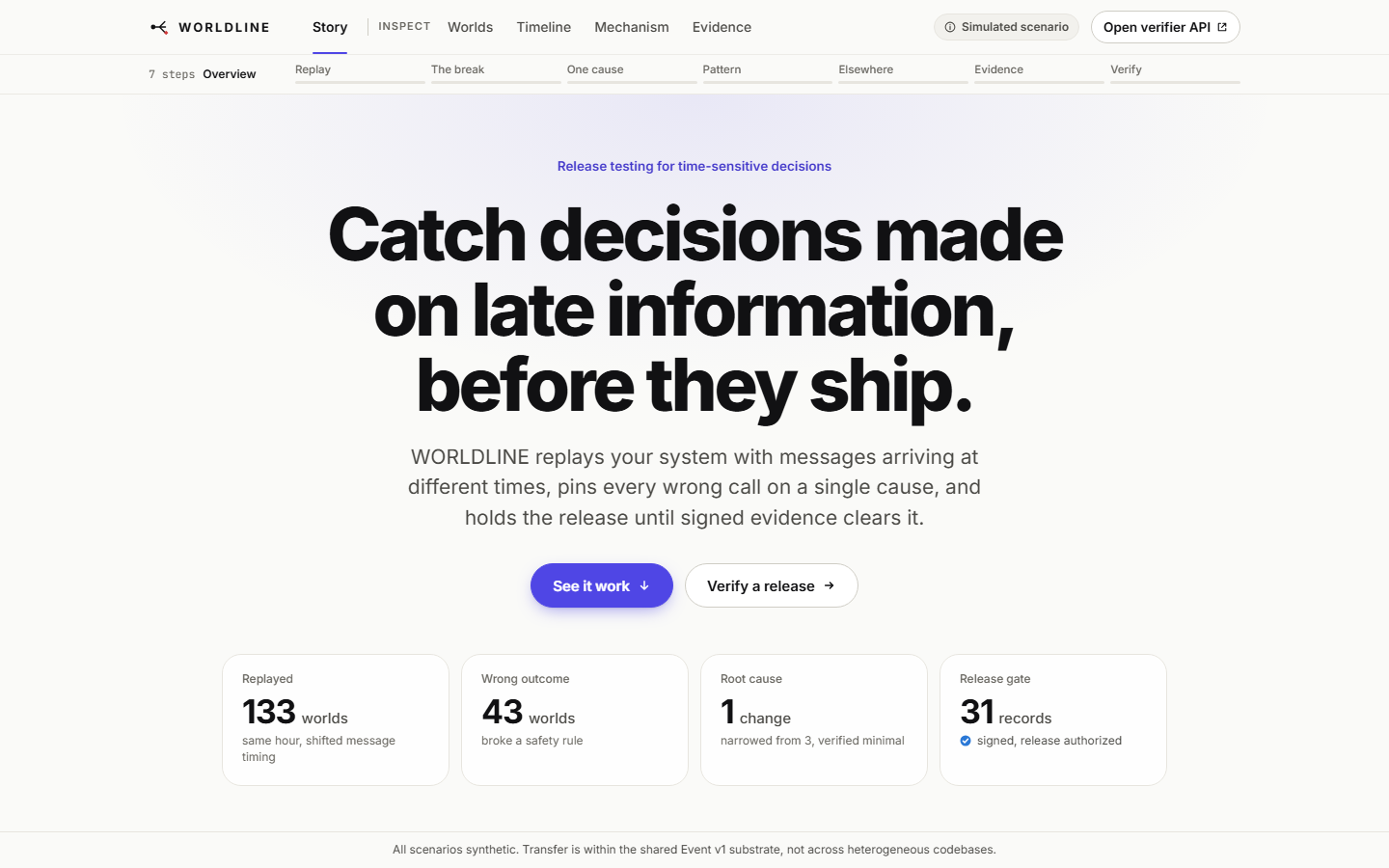
A scenario is a deterministic world: roles that observe events through their own delivery latencies, and actors that make rule-based decisions from what their role has received. WORLDLINE runs it once (the root world), then branches it under interventions such as delaying, dropping, or corrupting a delivery. Each branch is checked against three-valued invariants. See Worlds and Interventions.
2. The world that broke
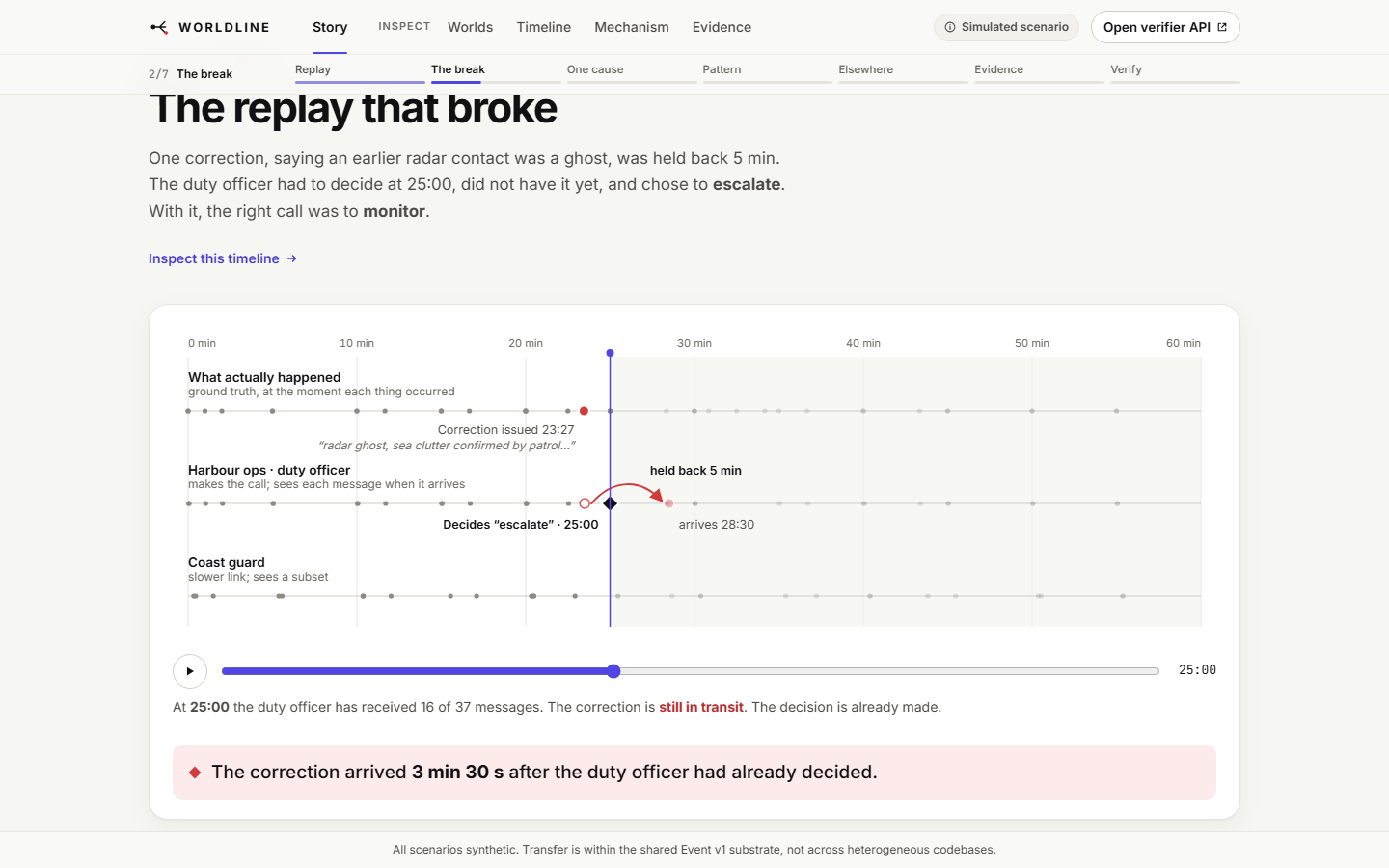
In the port_alert scenario, the duty officer decides at 1500 s whether to escalate. In the root world, a correction arrives in time and the decision is "monitor". In one branch, the same correction arrives late, and the officer escalates on stale information. The invariant decision.consistent_with_truth reports FAIL and names the events the officer had not yet received. See Invariants.
3. One cause, as a mechanism
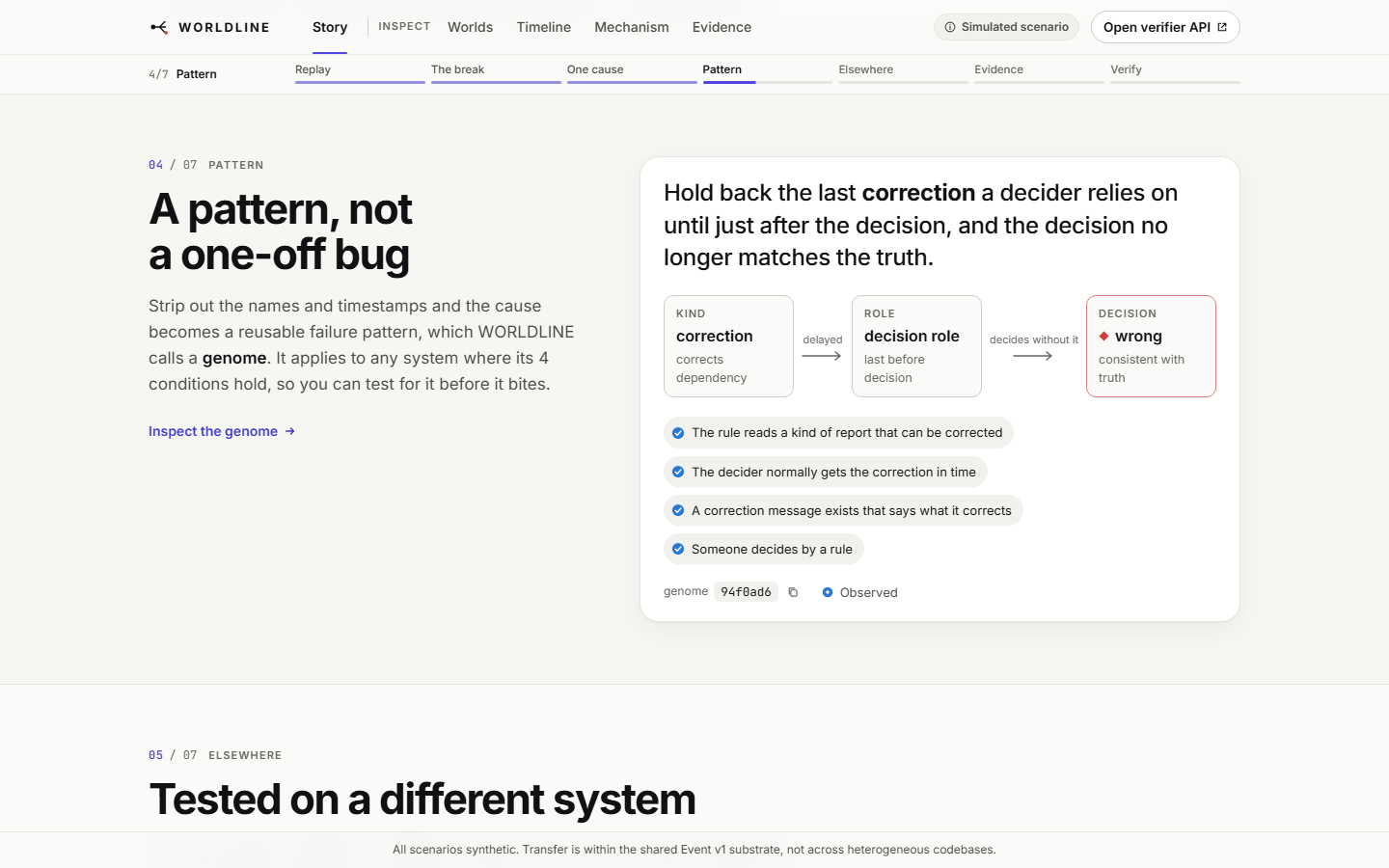
Delta debugging reduces the failing schedule to a 1-minimal cause, here a single delayed correction, and then checks minimality independently. WORLDLINE abstracts that cause into a failure genome, "delay the last correcting report a deciding role received before its decision", and challenges a second scenario with it. The genome reproduces on the convoy scenario and not on its deliberately immune control. See Minimization and Failure genome.
4. Nothing ships on untyped evidence
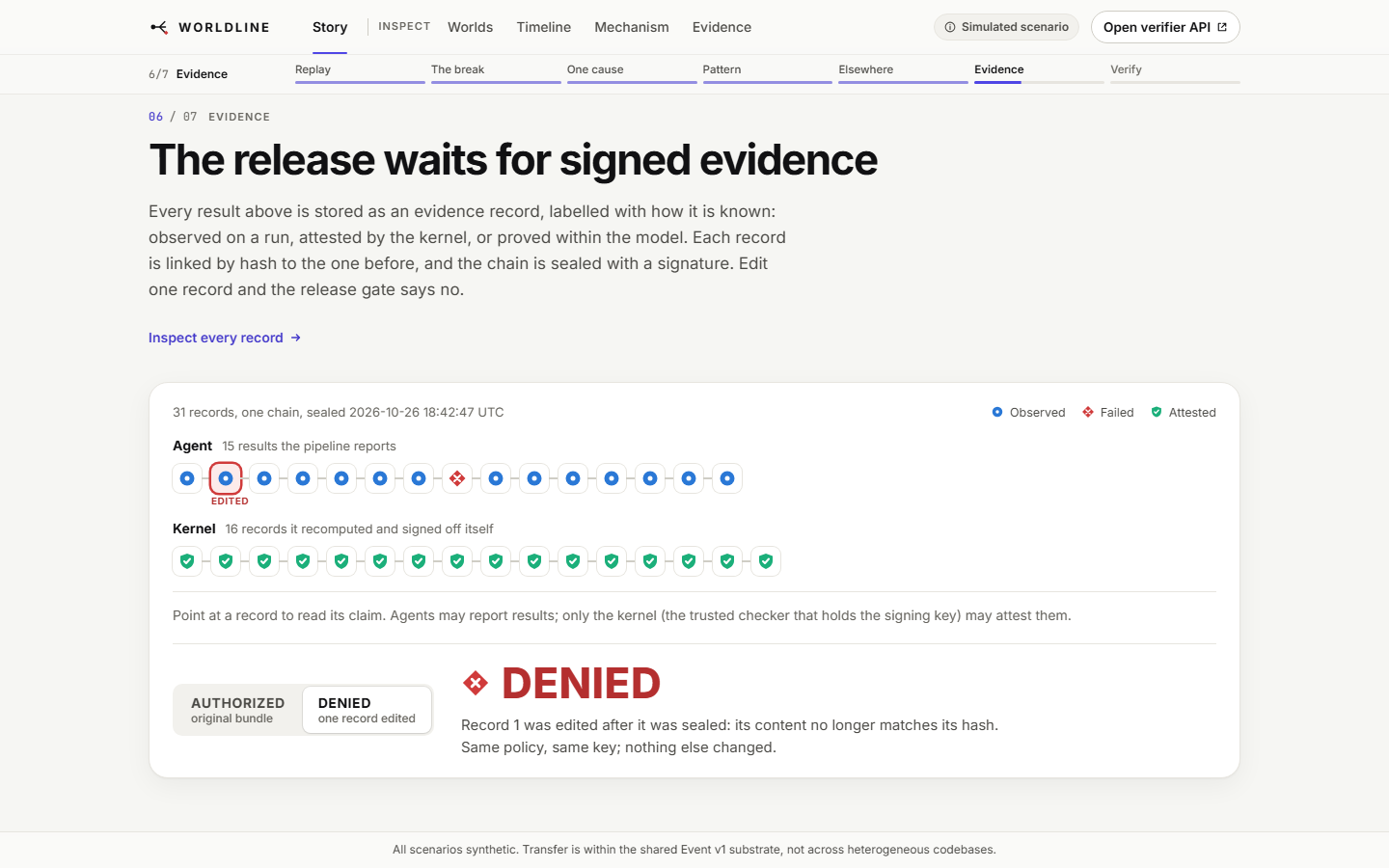
Every claim is typed: PROVED_WITHIN_MODEL, EMPIRICALLY_VALIDATED, ATTESTED, FAILED, or UNKNOWN. The kernel recomputes what agents reported, attests only what matches, and seals the chain with Ed25519. It authorizes a release for one exact commit only when the policy is met. A one-byte edit to the bundle is a DENIED with a named finding. See Evidence kinds and The kernel.
5. Every branch, inspectable
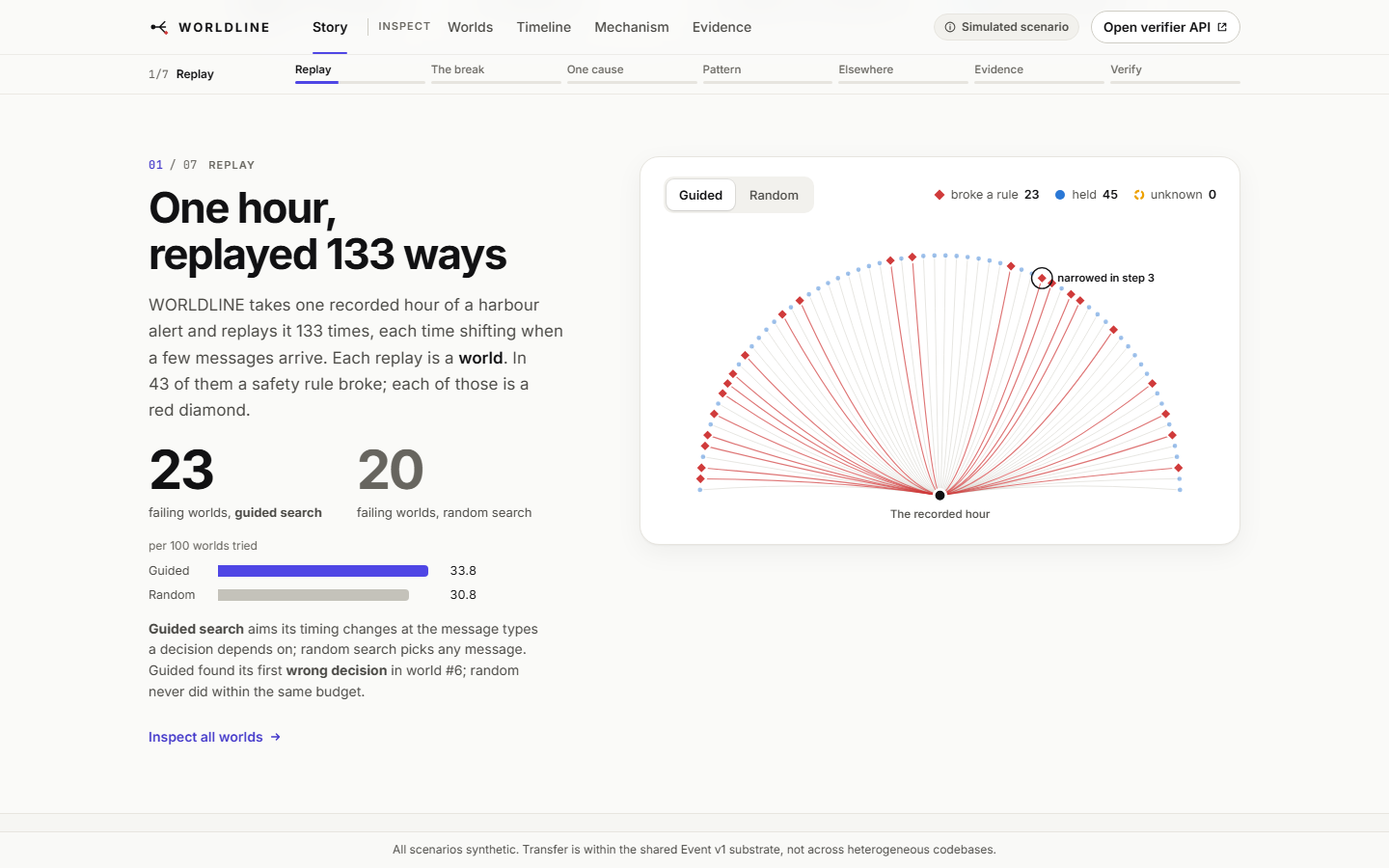
The viewer shows both exploration strategies as branch trees, the per-role timelines with information lag, the causal diff against the root, and the evidence chain. It is static and published next to these docs.
The whole chain in one command
The demo explores, minimizes, extracts the genome, challenges the second scenario, writes the agent evidence, runs the kernel, and authorizes. It ends with AUTHORIZED, then shows DENIED for a deliberately tampered bundle. Run it yourself.
How it fits together
flowchart LR
  S[scenario.yaml] --> R[run worlds]
  I[interventions] --> R
  R --> C{invariants<br/>PASS / FAIL / UNKNOWN}
  C -- FAIL --> M[minimize<br/>1-minimal cause]
  M --> G[genome<br/>portable mechanism]
  G --> X[challenge<br/>another scenario]
  C & M & X --> E[typed evidence]
  E --> K[kernel<br/>recompute, attest, seal]
  K --> A[AUTHORIZED / DENIED<br/>for one commit]
Where to go next
| If you want to | Read |
|---|---|
| Install and run it | Install, First run |
| Understand a result | Read the output |
| Learn the model | Concepts |
| Write your own world | Author a scenario, Scenario schema |
| Gate releases on GitLab | GitLab workflow, Releases and verification |
| Check a release from outside | Verifier API |
| Know what has been claimed and measured | Research |